Rumpelstiltskin’s Firstborn-Child Bargain
One Thousand and One NightsRumpelstiltskin’s Firstborn-Child Bargain is the concealed cost of the deal between Rumpelstiltskin and Della de Courville’s father, a promise that binds the father’s family to a creature who has already framed wishes as transactions. The bargain’s reach becomes clearer only later: Rumpelstiltskin claims Della, threatens to take her at twenty-one, and expects to gain her inheritance as well. The episode links the peril of uninformed consent to the story’s larger contrast between property exchanged by contract and affection freely chosen.
The Bargain and Its Terms
The agreement begins with an argument about the rules. When Della de Courville’s father turns to his three wishes, Rumpelstiltskin insists that each wish requires a corresponding gift. The father objects that he was not told this, but the imp repeats the condition rather than answering the complaint. A witch should have explained it, he says, making the omission sound like the father’s failure to obtain advice rather than the bargain-maker’s failure to disclose the price.
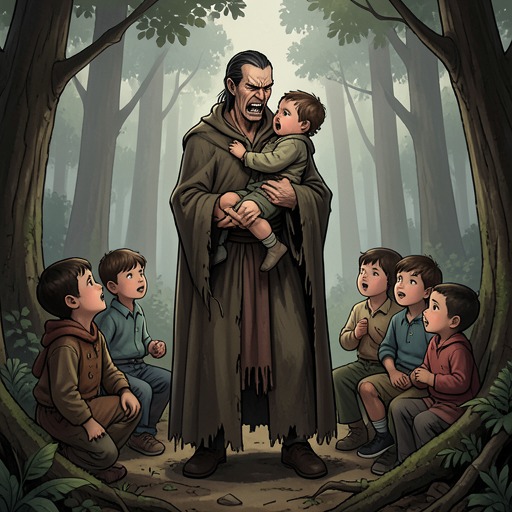
Rumpelstiltskin then presses the father to swear repeatedly. He asks for an oath on the father’s third toe and another by the hairs of his chin; the father agrees, saying that he has sworn three times. Rumpelstiltskin’s rosy cheeks glow with mischievous satisfaction as he declares, “No takebacks, no substitutions.” The rule closes off retreat before the father knows the full nature of what he has promised. The exchange is therefore not simply a negotiated price: its binding language is established while a crucial term remains undisclosed.
The father makes his vulnerability explicit when he says he has given nearly everything, with only his soul, the garment on his shoulders, and the tattered shoes on his feet excepted. He offers Rumpelstiltskin any worldly possession that might please him. The imp beckons him closer to reveal the third gift. The later account identifies the bargain as a demand concerning the father’s firstborn child, a claim that the father had tried to renegotiate but could not replace with another promise.
From a Promise to a Claim on Della
The father says that, after he used his third wish to put Rumpelstiltskin back into the lamp, the imp responded in a wild tantrum and declared that he would soon have Della. The father connects this threat to the bargain over his firstborn, though he remains baffled by why Rumpelstiltskin would want the family’s treasure when the creature can make his own. The apparent mismatch between the original demand and the later claim makes the bargain’s full purpose difficult for the family to understand.
The threat is also attached to a precise deadline. The father explains that Rumpelstiltskin has his mother’s necklace and his father’s ring as proof of his claim, and that when Della turns twenty-one she will be fully his. The father fears that the jinn’s hold is already beginning to affect her memory; soon, he says, she may not remember who she is. Once Rumpelstiltskin claims her, everything she is to inherit will pass to him. The bargain thus threatens not only possession of a child in the abstract, but Della’s identity, future, and inheritance under the terms Rumpelstiltskin asserts.
Della’s mother wonders whether Rumpelstiltskin can only spin straw into fairy gold, as the father found in his cave, and whether the real treasure he earned was the ability to provide for Della. Her suggestion reframes wealth as care rather than a hoard. The father resists the idea that Rumpelstiltskin could have loved a child who was not yet born, and suspects instead that the scheme concerns the inheritance. He recalls that he himself had been a bachelor, an orphan, and a street rat when he made the bargain, underscoring how little security he had when he accepted its terms.
The Father’s Choices and the Bargain’s Asymmetry
The father’s account does not present him as wholly powerless. He says that he used his first wish to obtain knowledge of how to acquire wealth rather than wealth itself, and his third to send Rumpelstiltskin back into the lamp, where the creature would be imprisoned. His wife calls these choices clever even as she reminds him that he was foolish to agree to a third promise before learning what it was. His resourcefulness limits Rumpelstiltskin’s power, but it cannot erase the consequence of the promise made without knowing its cost.
That contradiction gives the bargain its particular force. The father can reason about the wishes and use them strategically, yet he has already accepted a rule that forbids takebacks or substitutions. His wife’s insistence on his cleverness sits beside his self-reproach: he used one wish to gain the means to make wealth and another to imprison the imp, but agreed to the third obligation in ignorance. The arrangement rewards foresight in one part of the exchange while exploiting its absence in another.
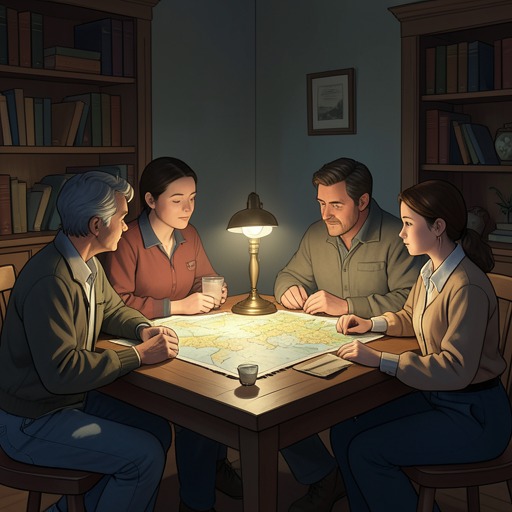
The father also explains that he hired Zaen because the young man knew the street and its goings-on. He trusted Zaen to find the missing lamp, offered him a fortune, and says that Zaen accepted only a few pieces to pay his street informants. The father’s decision to seek help shows that the family is trying to resist the claim rather than simply submit to it, but his account makes clear that he does not know how to ensure Rumpelstiltskin can be returned to the lamp. With less than a day before Della’s birthday, the threat has become both personal and urgent.
What the Bargain Cannot Define
The story eventually places the bargain’s transactional logic beside a different measure of love. At the confrontation with Rumpelstiltskin, Tad says that the greatest gift of all was true love. Paribanou recognizes the significance immediately: Rumpelstiltskin has promised someone true love, and she accuses him of cheating. His answer is that nobody will give him what he wants; Tante Iezavel replies that his desire is absurd and recalls their mother’s instruction that he should want something sensible. The imp’s demands for gifts and promises are set against a gift that cannot be secured simply by naming it as a contractual price.
The contrast also clarifies why repeated romantic offers need not amount to love. Zaen tells Della that he proposed a thousand times; she laughs that she had thought he was not counting, but distinguishes romance from love. He then speaks of loving the real Della, including the girl he first saw talking to her horse and jumping hedges, and describes the thousand and one attempts it took to reach her heart. His eventual proposal asks her to be his friend for life before asking her to marry him. Della accepts without gold or jewels, on the condition that he remain her dearest friend. Where Rumpelstiltskin’s bargain tries to turn a person into a claim, Della and Zaen’s promise rests on recognition and friendship rather than payment.
The bargain’s consequences end when Rumpelstiltskin is captured and the curse on Della is removed. Claire tells Zaen that the jinn has been captured and asks for the lamp, while Zaen clutches the lump hidden in his shirt. The demand for the lamp marks the practical effort to contain the creature whose bargain has endangered Della. The story does not treat Rumpelstiltskin’s formal claim as a legitimate bond merely because he has asserted it; his power is challenged, and Della’s future is separated from the inheritance he sought to acquire.
Significance
The firstborn-child bargain makes the story’s conflict about more than a clever wish or a supernatural trick. Its terms are shaped by an imbalance of information: Rumpelstiltskin insists on gifts and binding oaths before the father understands what the final obligation will demand. The phrase “No takebacks, no substitutions” gives the arrangement the appearance of certainty, but that certainty serves the party who withholds the crucial condition. The father’s later regret and his family’s fear show the human cost of treating an uninformed promise as irrevocable.
The bargain also supplies a dark counterpoint to the story’s romances. Rumpelstiltskin seeks a person as the outcome of an exchange, and his claim reaches into Della’s memory and inheritance. Zaen’s eventual success depends instead on acknowledging Della as she is and asking for friendship, which she freely grants. Against the imp’s insistence that every wish must have a price, the ending suggests that affection cannot be made genuine by a demand, a possession, or a tally of proposals.